Help after choking.

Medical care, support and someone to talk to, for anyone affected by choking.

Getting checked, and what to expect

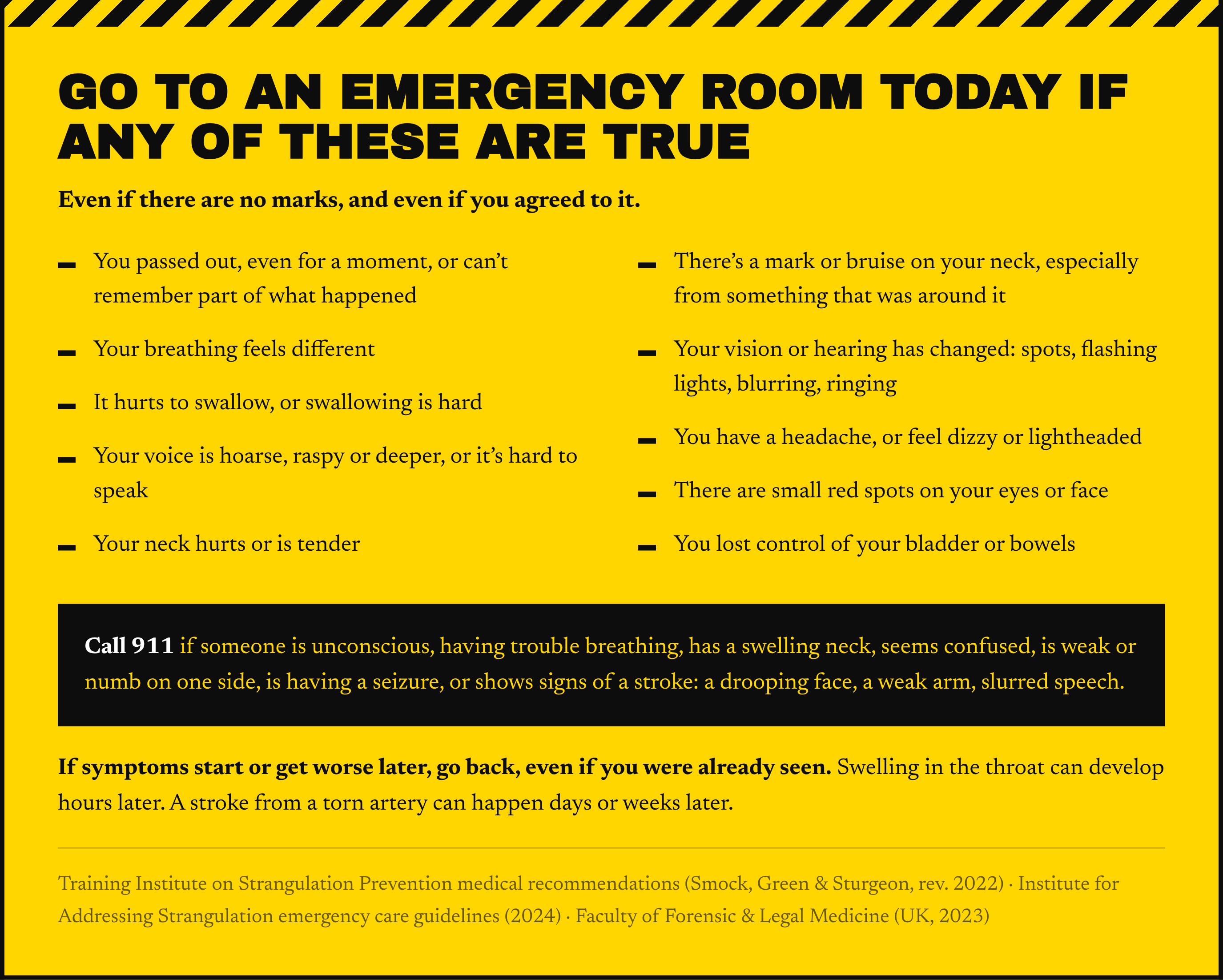
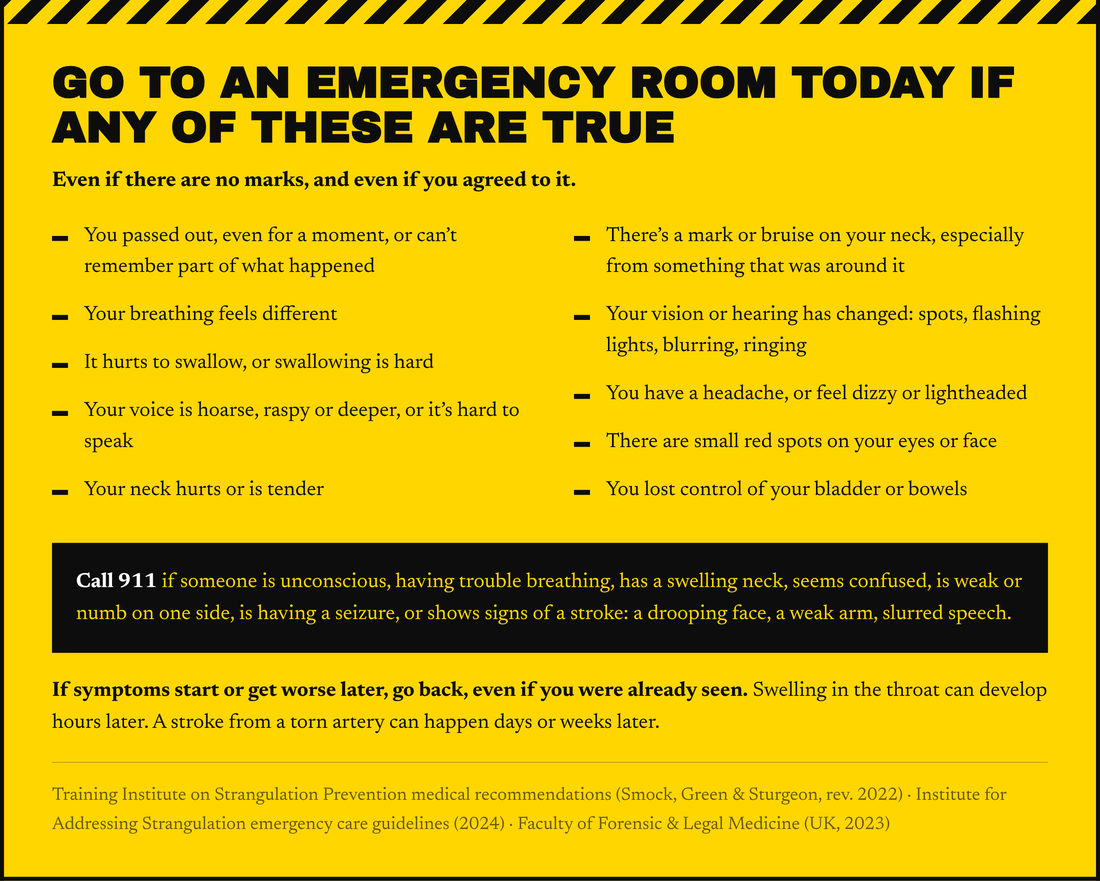
Go to an emergency room today if any of these are true

Even if there are no marks, and even if you agreed to it.

  • You passed out, even for a moment, or can’t remember part of what happened
  • Your breathing feels different
  • It hurts to swallow, or swallowing is hard
  • Your voice is hoarse, raspy or deeper, or it’s hard to speak
  • Your neck hurts or is tender
  • There’s a mark or bruise on your neck, especially from something that was around it
  • Your vision or hearing has changed: spots, flashing lights, blurring, ringing
  • You have a headache, or feel dizzy or lightheaded
  • There are small red spots on your eyes or face
  • You lost control of your bladder or bowels
Call 911

If someone is unconscious, having trouble breathing, has a swelling neck, seems confused, is weak or numb on one side, is having a seizure, or shows signs of a stroke: a drooping face, a weak arm, slurred speech.

Symptoms can show up later

If symptoms start or get worse, go back, even if you were already seen. Swelling in the throat can develop hours later. A stroke from a torn artery can happen days or weeks later.

Download this card as a PNG →

Training Institute on Strangulation Prevention medical recommendations (Smock, Green & Sturgeon, rev. 2022) · Institute for Addressing Strangulation emergency care guidelines (2024) · Faculty of Forensic & Legal Medicine (UK, 2023)

Today

What to expect at the ER or urgent care

Doctors check for injuries inside the neck and brain, which often leave no marks. What you tell them and the signs they find decide which tests you get.

At the front desk

Tell the triage nurse you were strangled, or that someone put pressure on your neck. If you only say your throat hurts, they may not check for the injuries strangulation causes. Say how long you think it lasted, whether you passed out even for a few seconds, and whether a belt, a cord, an arm or anything else was around your neck. Those details decide which tests you get.

The exam

The doctor or nurse looks at your neck, face and eyes for swelling, bruising and small red spots, listens to your voice and breathing, asks whether it hurts to swallow, and checks for numbness, weakness, confusion and gaps in your memory. They should talk with you alone, without the person who did it in the room, and you can ask for that.

The scan

If you have any warning sign, the recommended test is a CT angiogram: a CT scan of the blood vessels in the neck, done with dye in a vein so the arteries show up. It can find a tear in an artery wall, where a clot can form and cause a stroke. Plain X-rays and ultrasound are not adequate for this.

Why they may keep you

Swelling inside the neck can develop hours after strangulation and narrow the airway, so the emergency department may keep you for observation. They may admit you if there is any concern about your airway, if the scan finds an injury, or if home is not safe.

If you’re sent home

Ask for the warning signs in writing. If any symptom starts or gets worse, go back, even if you were already scanned. A drooping face, a weak arm or slurred speech at any point in the weeks after means call 911.

Your record

How to document it

Strangulation often leaves little to see. In a review of 300 cases, half had no visible neck injury, and another 35 percent had marks too small to photograph. Marks that do show up can take days to darken.

  • Take photos the same day, then again each day for several days, in natural light and from more than one angle.
  • Take one photo with your face and neck in the same frame.
  • Keep the originals. Don’t edit, filter or crop them.
  • Write down what happened: the date, time and place, what was said, how long it lasted, and whether you blacked out.

Do this whether or not you plan to report. A forensic exam makes a stronger record.

Strack, McClane & Hawley, Journal of Emergency Medicine 21(3) (2001) · International Association of Forensic Nurses, strangulation documentation toolkit (2023)

Under 18

If you’re under 18

Doctors, nurses and school staff may have to report abuse of a minor. You can ask what they would have to report before you say more, and you can still get medical care.

A hospital doesn’t need to know who choked you to check your neck. Whether a parent is told depends on your state and your age. You can ask the hospital before the exam starts.

A school nurse can check your neck, tell you whether you need an emergency room, and call 911. A school nurse can’t order a CT scan or do a forensic exam.

Evidence

The forensic exam

A forensic exam, sometimes called a SANE exam or a rape kit, is done by a specially trained nurse or doctor. They photograph and measure injuries, including on the neck, write down what happened in your words, and collect swabs and clothing. You can stop or skip any part.

You don’t have to decide about reporting first. Federal law requires states to provide the exam free, whether or not you report to police. The evidence can be kept while you decide.

Go as soon as you can. Many programs collect evidence up to 72 hours afterwards, some for longer. Try not to shower or change clothes first, but go even if you have. Not every hospital has a forensic nurse. RAINN, 800-656-4673, can tell you where to go.

Dating violence

If a partner uses choking to control you

A partner choking you to scare or control you is abuse, during sex or not. That includes a hand on your neck in an argument, choking during sex after you said no, and choking to stop you talking or leaving.

It is one of the strongest warning signs that abuse will turn deadly. Women who had been strangled by an abusive partner had 7.48 times the odds of later being killed by that partner.

Glass et al., Journal of Emergency Medicine 35(3) (2008)

Hotlines & support

Someone to talk to, right now.

If someone is unconscious, having trouble breathing, or in danger right now, call 911 first. Every line below is free and confidential.

National Sexual Assault Hotline (RAINN)

If you were choked without agreeing to it.

988 Suicide & Crisis Lifeline

For any crisis, including thoughts of suicide.

love is respect

If a relationship feels controlling or unsafe.

National Domestic Violence Hotline

For abuse by a partner, at any age.

The Trevor Project

For LGBTQ+ young people.

Vibe Check

If you’re worried you hurt someone.

Crisis Text Line

For anything that feels like too much.

Childhelp National Child Abuse Hotline

If an adult in your life is hurting you.

StrongHearts Native Helpline

For Native Americans and Alaska Natives.

For young people

What to say if someone wants to choke you.

Pick what’s happening
Say

“No. Not my neck. I’m not into that.”

You don’t need a reason, and you can say it again.

Then
  • You don’t have to explain yourself, and you can stop everything right there.
  • If they ask again or keep pushing after your no, that’s pressure, and you can leave.
  • Saying yes before doesn’t mean you have to now. You can stop it at any point.

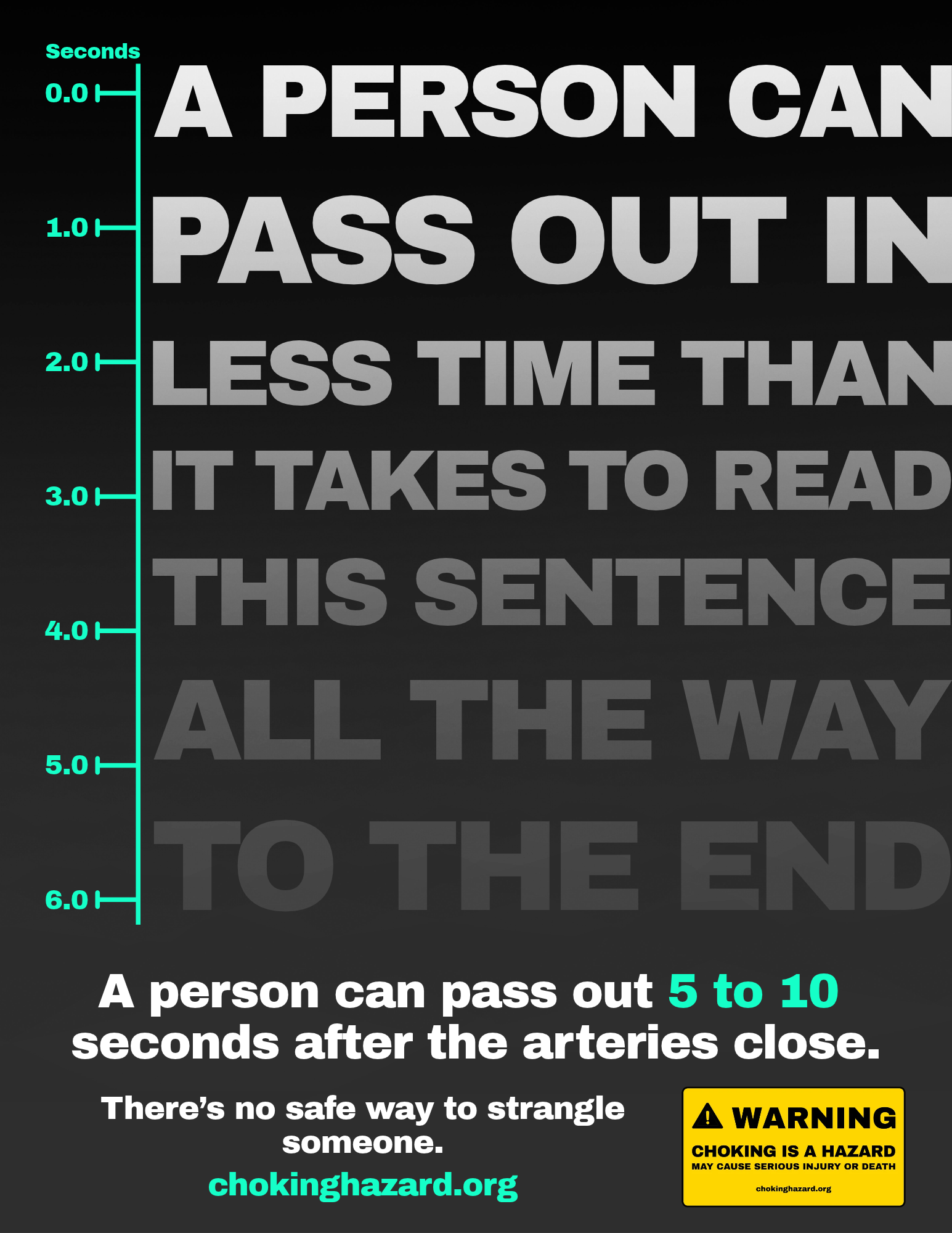
Why it mattersA person can pass out 5 to 10 seconds after the arteries to the brain close.

Say

“Stop. Get your hand off my neck.”

Say it as soon as you can. What happens after that is up to you.

Then
  • Check for warning signs: passing out, trouble swallowing, a hoarse voice or a headache.
  • Any one of those signs means going to an ER today, even if you feel fine now.
  • You can talk to someone now: call RAINN at 800-656-4673 or text HOPE to 64673.

You’re not alone21% of college students who had been choked said they were never asked first.

Say

“No. There’s no safe way to do it.”

It cuts off blood to the brain. You don’t have to do it.

Then
  • A safe word doesn’t make it safe. They can lose the ability to speak within seconds.
  • You may not be able to tell they’re about to pass out until it has already happened.
  • If they’re hurt, you may be held legally responsible, even though they asked you to.

The lawEvery US state has a felony strangulation law, and agreeing to it isn’t always a defense.

Know this

“Even if they say yes, that doesn’t make it safe.”

There’s no safe way to choke someone. It can’t meet the pillars of consent, even if you both agree to it first.

Then
  • Pressure on the neck cuts blood and oxygen to the brain. People pass out within seconds.
  • A torn artery can cause a stroke days or weeks later, without a mark on the neck.
  • If they’re hurt or die, you may be held legally responsible, even if they agreed to it.

Already did it?Vibe Check, at checkyourvibe.org, is a private way to reflect on what happened.

Sources: Training Institute on Strangulation Prevention; Herbenick et al., Sexuality Research and Social Policy (2025); Alliance for HOPE International.

For adults

Talking with young people about it.

Downloads

Free posters and labels.

Free to download, print and share.

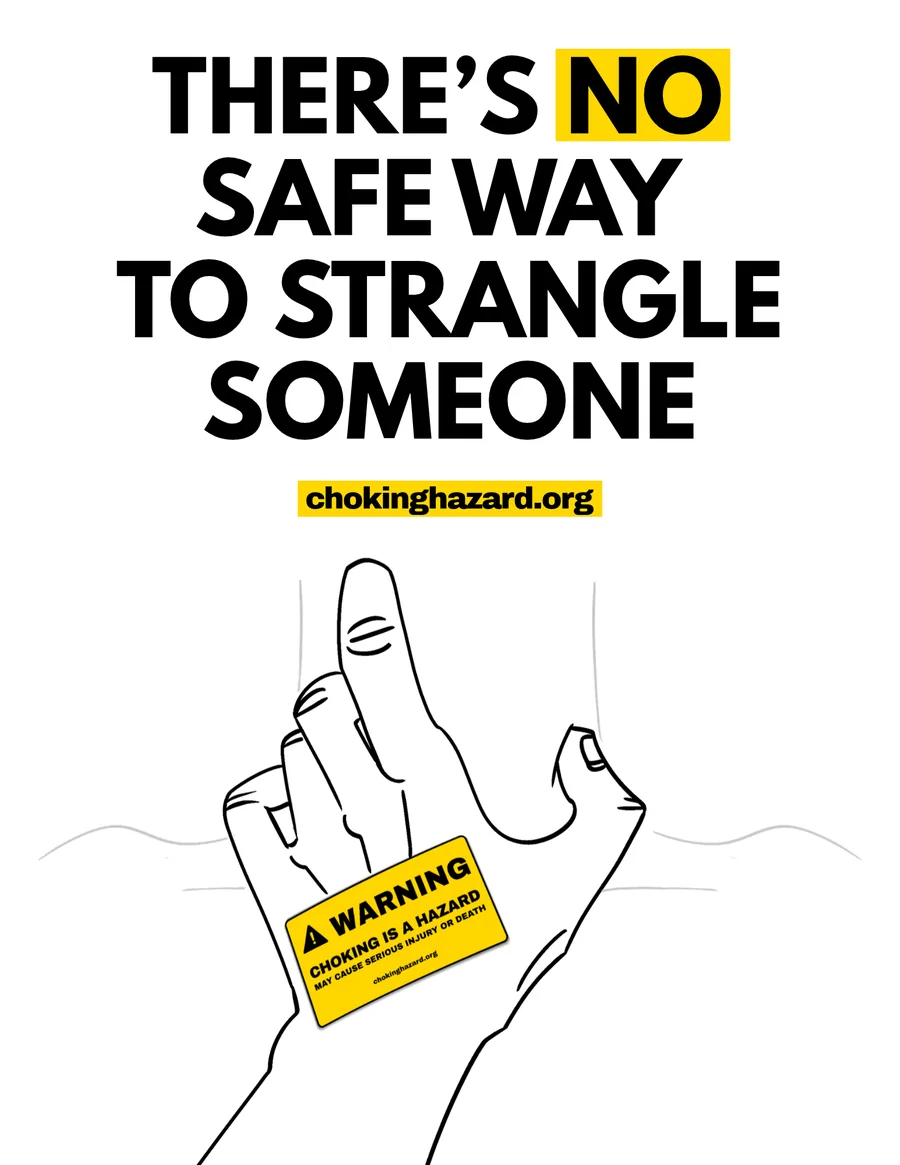
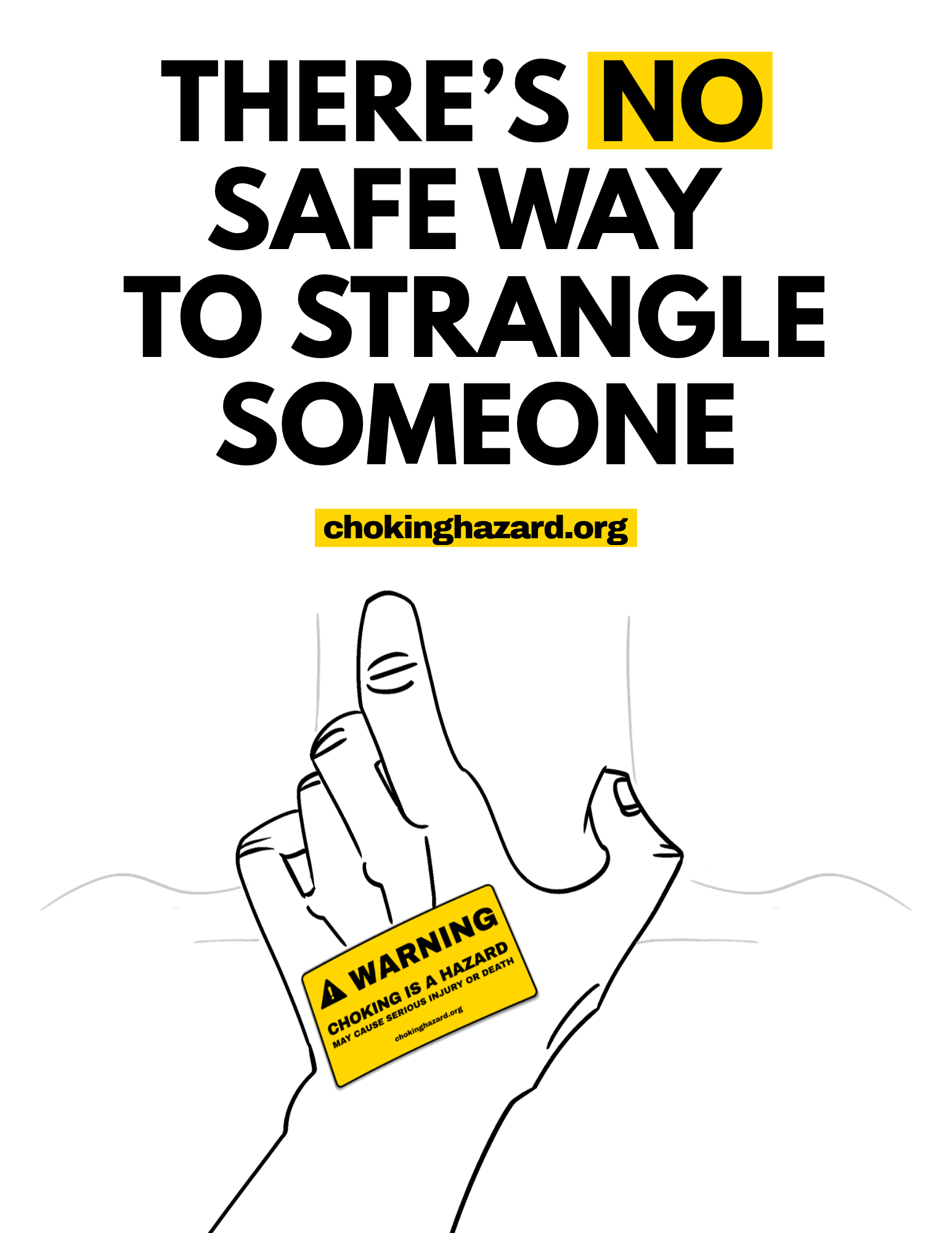
No Safe Way poster: a line-drawn hand in a strangling position with the campaign’s yellow warning label on it, under the headline There’s no safe way to strangle someone. chokinghazard.org

The No Safe Way poster

A drawn hand with the campaign’s warning label on it. There’s no safe way to strangle someone. Letter size.
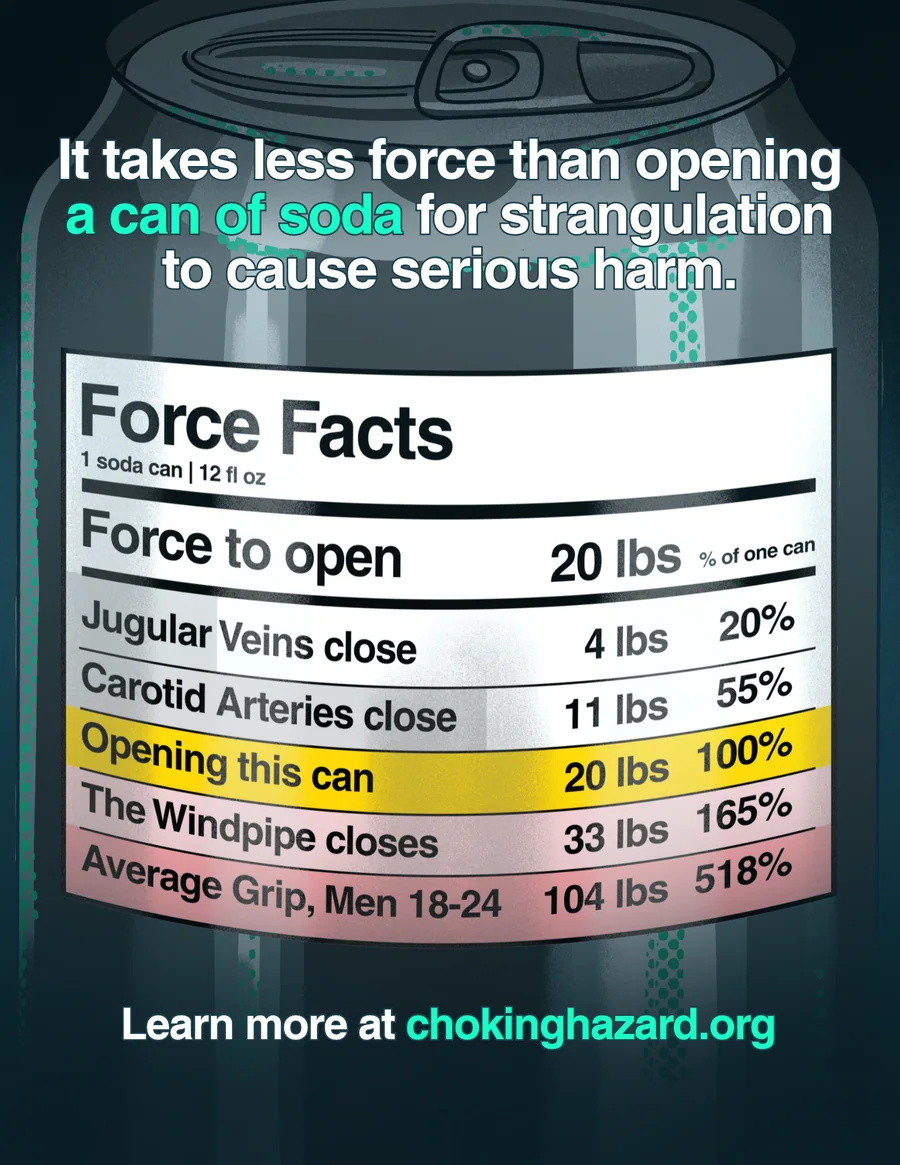
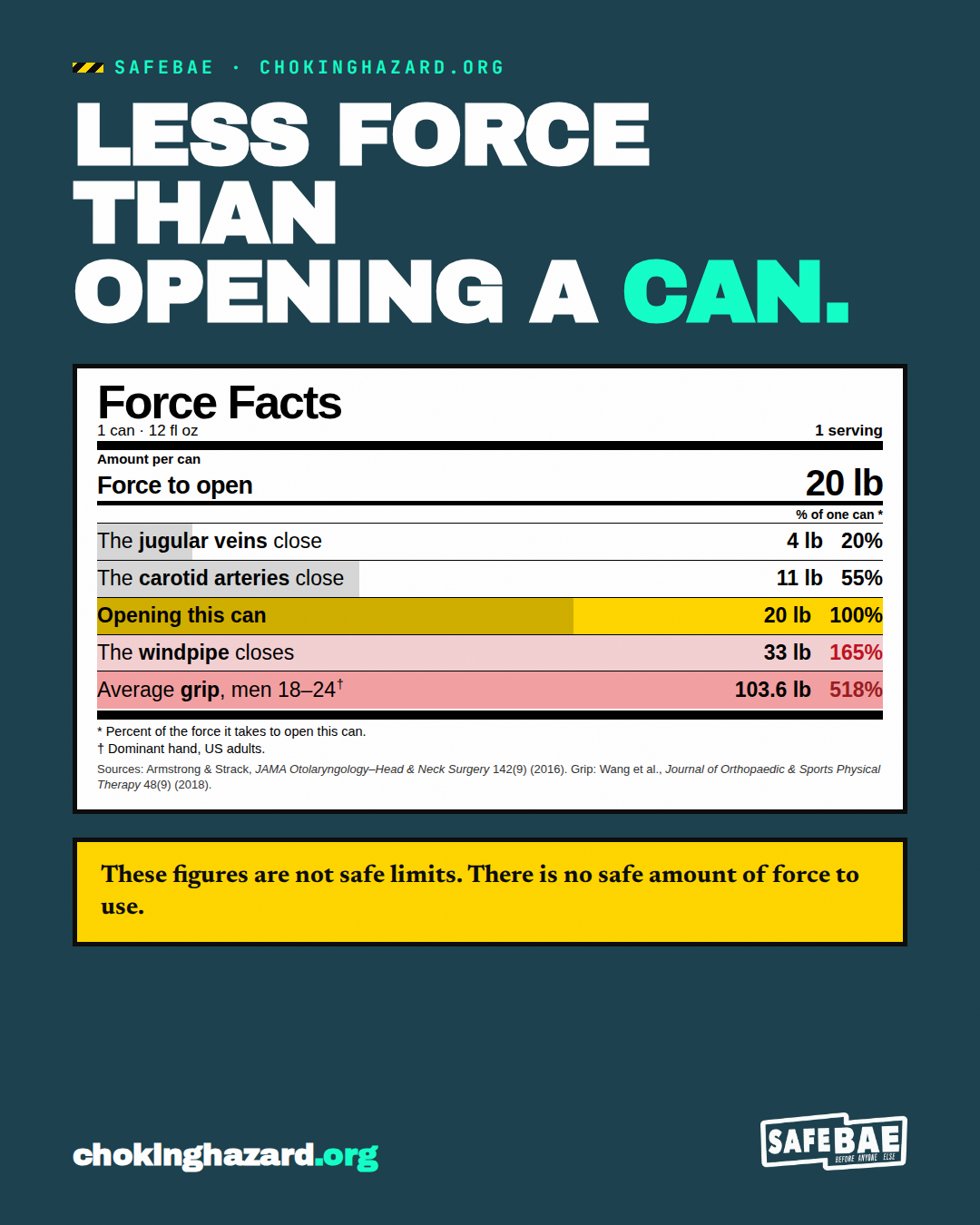
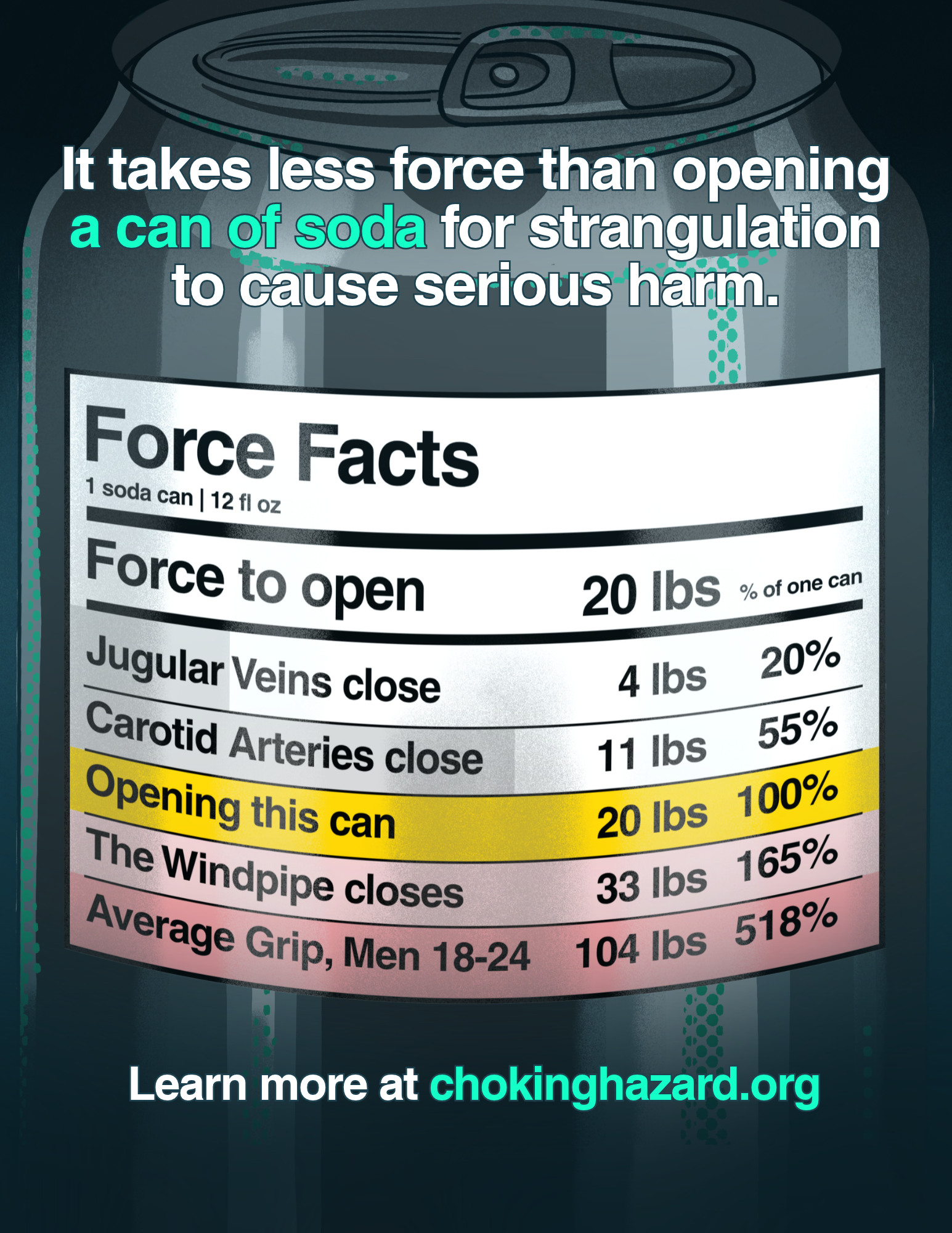
Force Facts poster: a soda can with a nutrition-style label. It takes less force than opening a can of soda for strangulation to cause serious harm. The jugular veins close at 4 lb, the carotid arteries at 11 lb, opening the can takes 20 lb, the windpipe closes at 33 lb, and the average grip of men 18 to 24 is 104 lb. Learn more at chokinghazard.org

The Force Facts poster

The Force Facts label on a soda can. Strangulation can cause serious harm with less force than it takes to open one. Letter size, in mint, white or yellow.
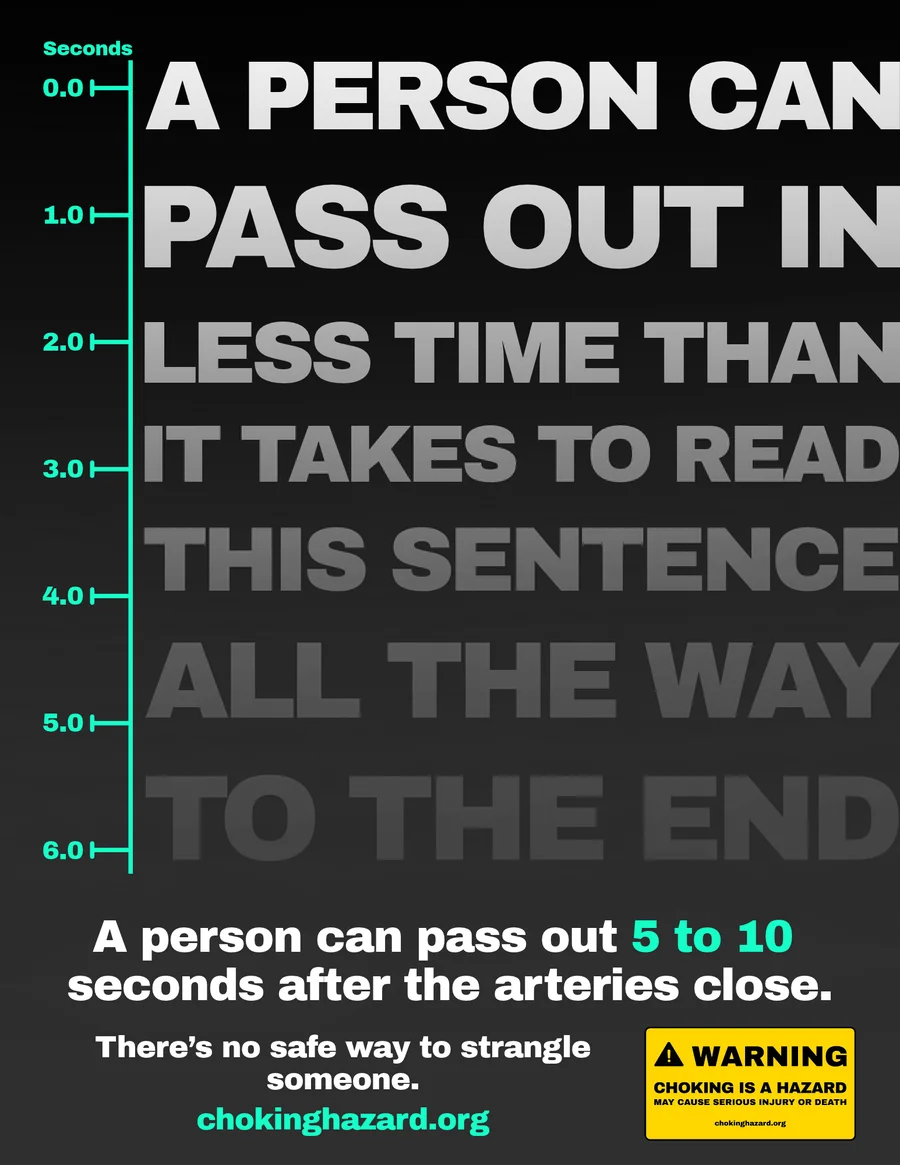
Seconds poster: a person can pass out in less time than it takes to read this sentence all the way to the end, set against a timer from 0 to 6 seconds. A person can pass out 5 to 10 seconds after the arteries close. There’s no safe way to strangle someone. chokinghazard.org

The Seconds poster

A person can pass out 5 to 10 seconds after the arteries in the neck close. There’s no safe way to strangle someone. Letter size.
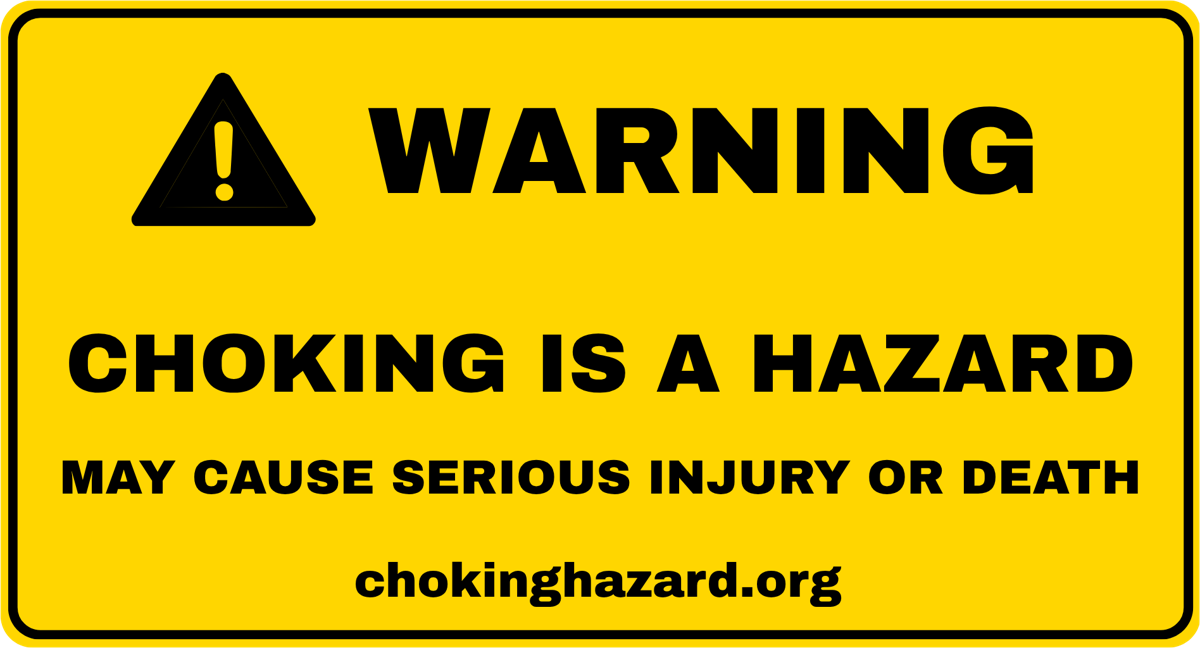
The Warning Sticker on yellow: choking is a hazard. May cause serious injury or death. chokinghazard.org

The Warning Sticker

The campaign’s warning label, in yellow or aqua.

Force Facts label: the jugular veins close at 4 lb, the carotid arteries at 11 lb, opening a can takes 20 lb, the windpipe 33 lb.

The Force Facts label

The force it takes to close the jugular veins, the carotid arteries and the windpipe, compared with opening a can.

Warning-signs card: go to an emergency room today if any of these are true, even if there are no marks and even if you agreed to it.

The warning-signs card

The signs that mean go to an ER today, when to call 911, and what to do if symptoms start later.